
Blogs and Testimonials
Here is where you can learn more about Dulwich Physio, the team and useful information about healthcare.

September is PCOS Awareness Month, & this year there’s an important new development to talk about: PCOS has a new name.
In May 2026, Polycystic Ovary Syndrome (PCOS) was renamed Polyendocrine Metabolic Ovarian Syndrome (PMOS) following a major international consensus process.
If you have PCOS, you might be wondering: Why change the name? Do I still have PCOS? Does PMOS mean something different? And does any of this actually change what I should be doing?
The short answer is that PMOS is not a new condition. The new name is intended to more accurately describe the condition we already know, moving the focus beyond ovaries and so-called “cysts” to recognise its wider hormonal, metabolic & reproductive features.
Having worked across Diabetes, Women’s Health, Fertility and Metabolic Health for more than two decades, this change makes a lot of sense to me. In clinical practice, PCOS has never looked like simply an “ovarian” condition. The women I see often come with a much wider range of concerns, from irregular cycles & fertility to weight, insulin resistance, diabetes risk and increasingly, confusion about what they should actually be eating.
Why was PCOS renamed?
The name Polycystic Ovary Syndrome has always had problems. Perhaps the biggest is that you don’t actually need to have polycystic ovaries to have PCOS.
Despite the name, the “cysts” associated with PCOS aren’t ovarian cysts in the usual sense. What may be seen on an ultrasound is an increased number of small ovarian follicles. Depending on your individual presentation & diagnostic criteria, an ultrasound may not even be required to make a diagnosis.
The old name therefore placed enormous emphasis on one feature of a condition that is much more complex.
PCOS can affect menstrual cycles & ovulation, androgen levels, skin & hair, fertility, metabolic health & psychological wellbeing. Insulin resistance is an important feature for many people with the condition, & PCOS/PMOS is associated with an increased risk of impaired glucose regulation & type 2 diabetes.
In other words, PCOS was never simply an ovarian condition.
The new name is intended to reflect that.
What does PMOS stand for?
PMOS stands for Polyendocrine Metabolic Ovarian Syndrome.
Each part of the new name tells us something about the condition:
Polyendocrine recognises that several interconnected hormonal systems can be involved, rather than the condition being explained by the ovaries alone.
Metabolic recognises the important relationship between PMOS & metabolic health, including insulin resistance, glucose regulation & increased risk of type 2 diabetes & other metabolic risk factors.
Ovarian retains recognition of the ovarian & reproductive features of the condition, including altered ovulation & menstrual cycles.
Syndrome remains important because PMOS isn’t one symptom or one abnormal blood result. It describes a collection of features that can present very differently from one person to another.
Who decided to change the name?
This wasn’t simply a group of clinicians deciding that PCOS needed a rebrand.
The name change followed a large international consensus process involving people living with PCOS alongside clinicians, researchers & patient organisations.
The process involved 56 leading academic, clinical & patient organisations & 14,360 survey responses from people with PCOS & multidisciplinary health professionals around the world.
The work considered not only scientific accuracy but also clarity, stigma, cultural appropriateness & how realistically a new name could be implemented internationally.
The consensus was that Polyendocrine Metabolic Ovarian Syndrome (PMOS) describes the condition more accurately than Polycystic Ovary Syndrome.
So do I have PCOS or PMOS?
If you have previously been diagnosed with PCOS, you haven’t suddenly developed a different condition. PMOS is the new name for PCOS.
And don’t worry if your GP, hospital letters, medical records, websites or even health professionals continue to use the term PCOS for some time.
The international implementation plan recognises that PCOS and PMOS will coexist during a transition period while healthcare systems, clinical coding, research, education and public understanding catch up with the new terminology.
So for now, you’re likely to see both:
PMOS (formerly PCOS) or PCOS/PMOS
Throughout my own articles, I’ll use both terms during this transition. PCOS remains the term most people currently recognise, while PMOS is gradually becoming established.
Does the name change how PCOS/PMOS is diagnosed or treated?
Not immediately.
The current international guidance has been updated to incorporate the new terminology, but the clinical features, diagnostic criteria & management approach haven’t suddenly changed because the name has changed.
What the new name may change (and what I hope it will change) is how we think about the condition.
For years, many women have experienced PCOS care largely through the lens of periods, fertility, weight or contraception.
Those things matter enormously, but they’re not the whole picture.
Recognising PMOS as a condition with reproductive, hormonal & metabolic components should encourage us to take a broader view of health, including appropriate assessment of metabolic risk alongside management of the symptoms & priorities that matter to each individual woman.
Why does the word “metabolic” matter?
For me, the inclusion of the word “metabolic” is one of the most important aspects of the new name.
I have specialised in diabetes since 2003 & have worked extensively across Diabetes, Pregnancy, Fertility, Women’s Health and Metabolic Health. One thing that experience has taught me is that metabolic health cannot be reduced to someone’s weight, and neither can PCOS/PMOS.
Insulin resistance is an important feature of PMOS, although it doesn’t affect everyone in exactly the same way.
Having PMOS also doesn’t mean that you have diabetes, and developing diabetes is certainly not inevitable.
What it does mean is that metabolic health deserves appropriate attention.
That can include considering glucose regulation and diabetes risk, blood pressure, blood lipids, weight and body composition where relevant, movement and physical activity, nutrition and other individual health factors.
Crucially, this should not translate into telling every woman with PMOS to lose weight, eliminate carbohydrates or follow an unnecessarily restrictive diet.
Does everyone with PCOS/PMOS need to lose weight?
No.
This is an area where I think women with PCOS have been particularly poorly served by oversimplified advice.
Over the years, I’ve met many women who have come away believing that weight loss is the treatment for PCOS, or that they’ve somehow failed if losing weight has been difficult.
That’s far too simplistic.
Women with PCOS/PMOS exist across the weight spectrum. Not everyone needs or wants weight loss, and lifestyle changes can improve health even in the absence of weight loss.
For some women, weight management may be an appropriate part of their treatment plan. For others, the priorities may be improving diet quality, supporting fertility, addressing metabolic risk, increasing physical activity, managing symptoms, improving their relationship with food, or simply understanding which of the enormous amount of PCOS advice online actually applies to them.
There is no single “PMOS diet” that everyone needs to follow.
The next article in this series will address what you should actually eat if you have PCOS/PMOS.
References
Teede HJ, Bahri Khomami M, Morman R, et al. Polyendocrine metabolic ovarian syndrome, the new name for polycystic ovary syndrome: a multistep global consensus process. The Lancet. 2026;407:2329–2339. doi:10.1016/S0140-6736(26)00717-8.
International Evidence-based Guideline for the Assessment and Management of Polyendocrine Metabolic Ovarian Syndrome (PMOS, formerly PCOS). 2026 update.
Published: September 2026 | Next review: August 2027
More Posts
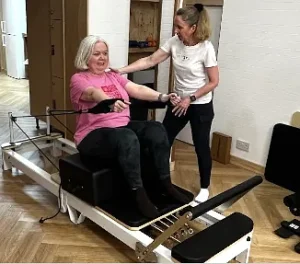
New! One-to-One Reformer Pilates
with Expert Physio Kay – Personalised Training, Real Results We’re thrilled to introduce our newest offering at Dulwich Physio: 1-to-1 Reformer

Southwark High Street winners!
Dulwich Physio are excited to announce that we’re one of 16 high street businesses to be awarded a ‘Southwark High

Dulwich Physio have moved
After many, many years at Dulwich Medical Centre, Russell Campbell, owner of Dulwich Physio, and the Dulwich Physio team have moved
New! One-to-One Reformer Pilates
with Expert Physio Kay – Personalised Training, Real Results We’re thrilled to introduce our newest offering at Dulwich Physio: 1-to-1 Reformer
Southwark High Street winners!
Dulwich Physio are excited to announce that we’re one of 16 high street businesses to be awarded a ‘Southwark High
Dulwich Physio have moved
After many, many years at Dulwich Medical Centre, Russell Campbell, owner of Dulwich Physio, and the Dulwich Physio team have moved
To see more testimonials, please go to our Google reviews